7 vegetarian meals kids will actually eat — no hidden vegetables, no bribing, no separate dinners

- Updated on Apr 16, 2026
I want to say something slightly controversial before we get into the list: I do not believe in hiding vegetables.
I understand the impulse. You are tired, your child has rejected the same dinner three nights running, and blending a courgette into the pasta sauce feels like a reasonable solution to an unreasonable situation. But here is the problem with the hidden vegetable approach — it does not teach children anything about food. It gets the nutrients in, which matters, but it does not help a child learn to eat a broader range of things over time. And that broader range is what you are actually trying to build.
What I have found, both through cooking for my own son and through years of thinking carefully about how food works for real families, is that children eat more willingly when the food is genuinely delicious, visually appealing, and gives them some agency over what ends up on their plate. The meals on this list are built on those principles.
The vegetables are visible. The flavours are honest. And none of them require you to cook two separate dinners — one for the adults and one for the children — which is the culinary equivalent of running two households and a recipe for burning out on cooking entirely.
My husband is not vegetarian, so every meal I put on the table has to work for both of us as well as our son. These seven have passed that test repeatedly.
1) Quesadillas with black beans, cheese, and roasted corn
Quesadillas are one of the most reliable family dinners in existence, and they are almost infinitely variable once you have the basic format working. A flour tortilla, a generous layer of grated cheese, and a filling that melts into the whole thing when pressed in a hot pan — that is the structure. Everything else is a decision.
For this version: black beans drained and lightly mashed so they stay inside the quesadilla rather than rolling out, roasted corn kernels that add sweetness and a little char, and a good amount of cheddar or a Mexican cheese blend. Press them in a dry pan over medium heat until the cheese melts completely and the outside is golden and crispy.
Cut into triangles, serve with sour cream and a simple tomato salsa on the side, and let children dip at will. The dipping is important. It gives them control over how much of each element they eat, which dramatically increases the likelihood that they will eat it.
2) Tomato and ricotta pasta bake
A pasta bake is a dinner that does not require any negotiation. It is warm, it smells good, it involves cheese on top, and children recognise it as food that was made for them rather than food they are being asked to tolerate.
This version uses a simple tomato sauce — tinned tomatoes cooked down with garlic, olive oil, and a little dried oregano — stirred through cooked pasta with generous spoonfuls of ricotta and a handful of fresh basil if you have it. Pour it into a baking dish, top with grated mozzarella and parmesan, and bake at 200 degrees until bubbling and golden on top.
The ricotta adds a creaminess that makes the whole thing richer without any additional effort, and the baked cheese on top is the detail that makes children ask for seconds before they have finished their first serving.
3) Vegetable fried rice
Fried rice is one of those meals that looks more complicated than it is, and once you have made it a few times it becomes the kind of dinner you can produce in fifteen minutes using whatever vegetables are in the fridge.
The trick that most home cooks miss is using day-old rice — freshly cooked rice has too much moisture and ends up steaming in the pan rather than frying. Left in the fridge overnight, the grains dry out and separate properly, giving you that slightly charred, individual-grain texture that makes fried rice worth eating.
For a version children will eat reliably: cold cooked rice, eggs scrambled directly in the wok or pan before the rice goes in, frozen peas and corn added frozen so they cool the pan slightly and cook through in the residual heat, a little finely diced carrot, and a sauce of soy sauce and a small amount of sesame oil added at the end. Keep the flavours clean and not too strong — children tend to be more sensitive to intense seasoning — and serve with extra soy sauce on the side for the adults who want more.
4) Homemade veggie burgers with all the toppings
The reason most children reject veggie burgers is that most veggie burgers are not very good. They are either mushy in the middle, bland throughout, or fall apart before they make it from the pan to the plate. A burger that holds together, has a proper crust, and tastes of something is a completely different proposition.
These are made with a base of cooked and mashed chickpeas, grated carrot, finely chopped onion, an egg to bind, breadcrumbs, smoked paprika, cumin, and salt. Formed into patties, chilled in the fridge for thirty minutes so they firm up, then fried in a little oil until genuinely golden and crispy on both sides.
Serve in a soft bun with whatever toppings your children will accept — cheese, ketchup, lettuce, a slice of tomato — and let them build their own. Burger assembly is one of the better dinner activities for small children, and the investment they make in constructing the thing makes them significantly more likely to eat it.
5) Baked potato bar
A baked potato bar is less a recipe and more a system, and it is one of the most practical family dinners I know.
One large baking potato per person, rubbed with olive oil and salt, baked at 200 degrees for about an hour until the skin is crispy and the inside is fluffy, then split open and loaded with toppings. The toppings are where the family dinner happens: sour cream, grated cheese, baked beans, sweetcorn, butter, chives if your children will accept them.
What makes this work for families is the same thing that makes quesadilla dipping work — total control. Children who will not eat a composed plate will happily eat the same ingredients when they are the ones deciding what goes on top. It is not a trick. It is just an understanding of how children interact with food, and it is worth building your dinner strategy around it.
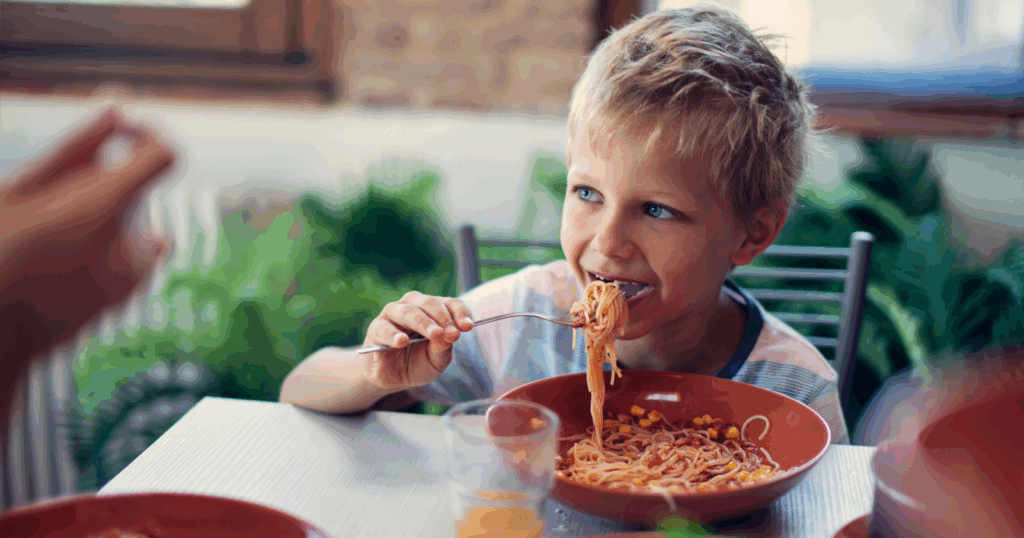
6) Lentil bolognese with spaghetti
This is the meal I feel most strongly about on this list, because it is the one that most consistently surprises people who assume their children will reject it. A lentil bolognese made properly — cooked long enough that the lentils break down slightly and the sauce thickens into something genuinely rich and savoury — is not a substitute for a meat bolognese. It is its own thing, and it is very good.
Brown or green lentils work best here. Soften onion, carrot, and celery in olive oil until completely tender, add tinned tomatoes, vegetable stock, a little tomato paste, dried herbs, and the lentils, and cook over low heat for at least forty minutes, adding stock as needed until the consistency is thick and cohesive. Season carefully at the end. Toss through spaghetti and finish with parmesan.
The texture is what wins children over. When the sauce is thick enough to cling to the pasta rather than pooling at the bottom of the bowl, it reads as satisfying in the same way a meat sauce does. The work is in the patience, not the technique.
7) Cheesy vegetable frittata fingers
Frittata works for family dinners for one specific reason: it can be cut into fingers, and finger food is almost universally accepted by small children in a way that plated food sometimes is not. There is something about being able to pick something up and eat it without utensils that removes a layer of resistance, and a well-made frittata holds together well enough to be picked up, waved around, and eaten in stages if that is what your child needs to do.
This version uses eggs whisked with a little cream and a generous amount of grated cheddar, poured over a base of sautéed courgette, red capsicum, and frozen peas cooked briefly in an ovenproof pan until softened.
The frittata starts on the stove until the edges are set, then goes into the oven at 180 degrees for about twelve minutes until just firm in the centre. Cool slightly, cut into strips or squares, and serve warm or at room temperature with bread on the side.
It also travels well in a lunchbox the next day, which is the kind of bonus that becomes genuinely important once you have a child whose packed lunch needs to feel considered rather than thrown together at seven in the morning.
The principle behind all of them
Every meal on this list follows the same logic: flavour first, format second, flexibility built in.
Children do not reject vegetables because they are vegetables. They reject food that does not taste good, food they have no agency over, and food that feels like it was made for someone else. Build around those three things and the separate dinner disappears.
The goal was never to trick anyone into eating well. It was to make food good enough that the question stops coming up.
Comments