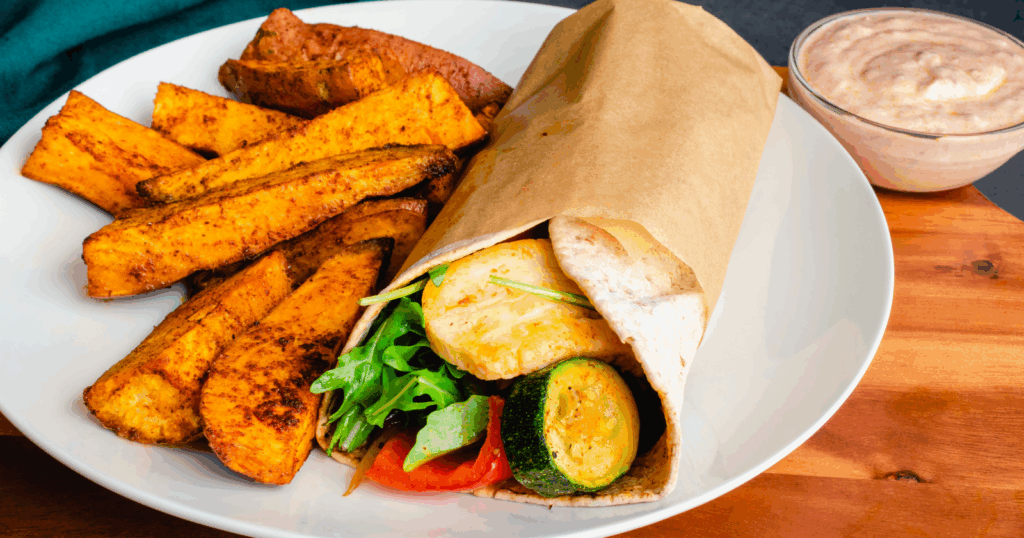
The crispy halloumi wrap I make when I need something fast, filling, and good enough to look forward to

- Updated on Apr 16, 2026
There’s a particular kind of hunger that hits around 1 PM on a Wednesday, when you’ve been up since dawn with a teething baby, answered three urgent emails during his morning nap, and suddenly realized you haven’t eaten anything except the cold toast crusts he rejected at breakfast.
This wrap was born from one of those moments, and it’s become my most reliable answer to the question of what to make when I need real food, fast.
The genius of this wrap isn’t just that it comes together in under fifteen minutes. It’s that every element earns its place: squeaky-salty halloumi that crisps up beautifully, a handful of whatever greens are lurking in the crisper, something creamy to bring it all together, and something acidic and punchy to cut through all that richness.
I’ve made this wrap at least twice a week for the past six months, and I still look forward to that first bite every single time.
The halloumi makes all the difference
Let’s talk about halloumi for a moment, because if you’re still buying the rubbery blocks that squeak against your teeth without much else going on, you’re missing out.
Find a good Middle Eastern grocer and get the proper stuff. It should smell faintly of mint and have enough salt to make you pause. When you fry it in a dry pan (no oil needed, it releases its own), it transforms into something completely different: golden and crispy outside, molten and salty inside, with those characteristic char marks that make everything taste better.
I slice mine about a third of an inch thick. Any thinner and it turns into halloumi crisps, which aren’t necessarily bad, but not what we’re after here. Too thick and you’re left with a squeaky center that reminds you why some people don’t like halloumi in the first place. The sweet spot gives you that perfect contrast between crispy exterior and creamy interior.
The key is high heat and patience. Don’t move it around. Let it sit there and sizzle until you can see the edges turning golden, about two to three minutes per side. You want proper browning here, not just warmed-through cheese. While it’s cooking, I usually get everything else ready because once that halloumi is done, you want to move fast.
Building layers that work together
While the halloumi is doing its thing, I warm my wrap directly over the gas flame if I’m feeling precise about it, or just throw it in the same pan after the cheese comes out if I’m not. You want it pliable and slightly charred in spots, but not crispy. We’re wrapping things here, not making a tostada.
For the green element, I usually reach for whatever’s handy. Rocket when I want something peppery, spinach when I’ve bought a bag for something else and need to use it up, or shredded cabbage when I’m thinking ahead since it stays crunchy even if you wrap this up for later. Sometimes I’ll add cucumber for crunch, or roasted red peppers from a jar when I’m feeling fancy.
The creamy element is non-negotiable. Hummus is my default, and I mean the good stuff with extra tahini if you’ve got it. But I’ve also used whipped feta, labneh, or even just Greek yogurt mixed with garlic and lemon when that’s what’s in the fridge. You need something rich enough to stand up to the salty cheese and provide a cooling contrast.
During my marketing days, I learned that the best campaigns have tension, something unexpected that makes you pay attention. Same principle applies here. That’s why the acidic element is crucial.
The element that brings it all to life
Here’s where this wrap goes from good to genuinely crave-worthy: you need something sharp and punchy. My favorite is a quick pickle situation with thinly sliced red onions that have sat in lime juice for five minutes while everything else comes together. But I’ve also used pickled jalapeños, a spoonful of harissa, or a handful of fresh herbs dressed with lemon juice.
Recently, I discovered that a spoonful of that bright green zhug from the Middle Eastern shop near the market takes this to another level entirely. Sometimes I’ll make a quick mixture of chopped fresh mint, parsley, and a squeeze of lemon. The point is to have something that cuts through the richness and keeps every bite interesting.
This acidic element isn’t optional. Without it, you’ve got a heavy, rich wrap that’ll leave you feeling sluggish. With it, every bite stays interesting, and you could honestly eat two of these without regret. Trust me on this one.
Getting the assembly right
Layer order matters more than you’d think. Spread your creamy element directly on the wrap first because it acts as glue. Then add your greens, making sure they’re distributed evenly. The halloumi goes on while it’s still warm, followed by your acidic element and any extras you’re using.
When you roll it, start from one end and roll tightly, tucking in the sides as you go. If you’re taking it somewhere, wrap it in foil and it’ll stay together beautifully. Sometimes I cut it in half on an angle because it looks better, and honestly, after morning chaos with the baby, I’ll take any small victory I can get.
I often make two at once, eating one immediately while standing at the counter and wrapping the other for later. It’s one of those rare things that tastes almost as good at room temperature as it does hot, which makes it perfect desk lunch material. You might have read my post on meal prep strategies, but this is the opposite approach: making something fresh that’s so quick it doesn’t need to be prepped.
Why this particular combination works
This wrap hits every note you want in a satisfying meal. You get salt from the cheese, fat from whatever creamy element you choose, freshness from the greens, and that crucial acidic punch that keeps your palate interested. It’s substantial enough that you feel properly fed, but not so heavy that you need a nap afterwards.
The vegetarian protein from the halloumi means you’re getting something that’ll actually keep you full until dinner. I’ve tried versions with grilled vegetables instead, but they never quite satisfy in the same way. There’s something about the heft and saltiness of halloumi that makes this feel like a proper meal, not just a vegetable wrap.
More importantly, it’s the kind of thing you can make on autopilot once you’ve done it a few times. I’ve assembled this one-handed while holding my son, I’ve made it during video calls with the camera off, and I’ve thrown it together using nothing but the dregs of various containers when I thought there was nothing to eat.
Making it yours
The beauty of having something like this in your repertoire is that it removes the friction from feeding yourself well. When you know you can have something this good in the time it takes to heat up leftovers, you’re more likely to make it. And when what you’re making involves crispy, salty cheese wrapped up with fresh, punchy flavors, that Wednesday afternoon suddenly looks a lot brighter.
Start with the basic formula: halloumi, something green, something creamy, something acidic. Once you’ve got that down, you can riff endlessly. Add pomegranate seeds when they’re in season. Throw in some toasted pine nuts if you’ve got them. Swap the wrap for flatbread if that’s what’s around. The point isn’t to follow a recipe exactly, but to understand why each element works so you can adapt based on what you have.
The real magic happens when this becomes muscle memory, when you can walk into your kitchen at 1 PM, exhausted and hungry, and know that in fifteen minutes you’ll be eating something that genuinely makes you happy. That’s not just lunch. That’s a small act of self-care wrapped up in a perfectly charred tortilla.
Comments